🌳 Trees
One-line summary: Hierarchical node structures — master traversals (inorder, BFS, DFS), BST properties, and path problems for O(n) or O(log n) solutions.
Visual Learning
Enhanced Tree Traversal Animation
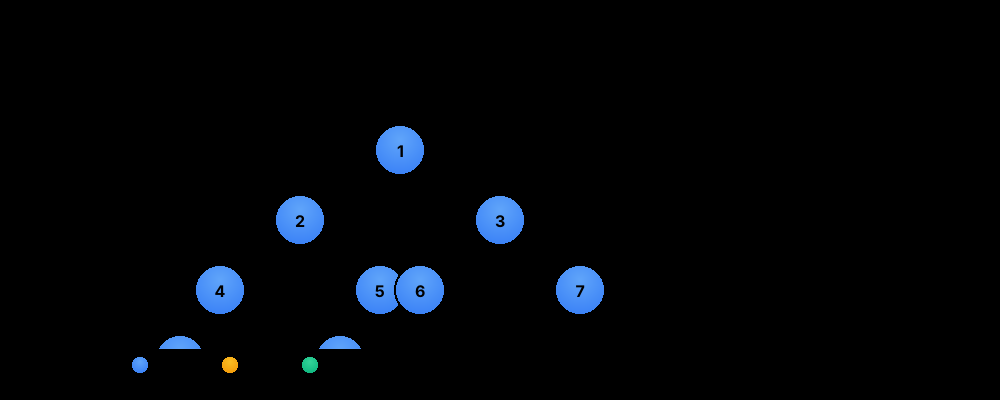 Interactive visualization of all tree traversal methods with smooth animations, node state changes, and real-time sequence display
Tree Operations Complexity Chart
 Visual comparison of time complexities for different tree operations
Core Concepts
What are Trees?
A tree is a hierarchical data structure consisting of nodes connected by edges. Unlike linear structures (arrays, linked lists), trees branch outward, making them ideal for representing nested or parent-child relationships.
Formally, a tree can be defined recursively: a node (the root) containing a value and a list of references to child nodes, with exactly one path between any two nodes and no cycles.
Key Terminology
| Term | Definition |
|---|---|
| Root | The topmost node with no parent |
| Leaf | A node with no children |
| Edge | The link between a parent and child node |
| Height | Length of the longest path from node to a leaf (edges) |
| Depth | Length of the path from root to node (edges) |
| Subtree | Any node and all its descendants, itself a valid tree |
| Sibling | Nodes sharing the same parent |
| Ancestor | Any node on the path from root to a given node (including the root) |
| Descendant | Any node reachable by repeatedly following child pointers |
Types of Trees
- Binary Tree: Each node has at most 2 children (left and right)
- Binary Search Tree (BST): Binary tree where left subtree values < node value < right subtree values
- Balanced Tree: Height difference between left and right subtrees is at most 1 (e.g., AVL, Red-Black)
- Complete Binary Tree: All levels filled except possibly the last, filled left to right
- Full Binary Tree: Every node has either 0 or 2 children
- Perfect Binary Tree: All internal nodes have 2 children, all leaves at same level
- N-ary Tree: Each node can have up to N children (e.g., Trie, file system)
Real-World Use Cases
- File systems — directories contain files and subdirectories (N-ary tree)
- HTML DOM — nested element hierarchy
- Database indexes — B-Trees and B+ Trees for efficient lookups
- Expression parsing — abstract syntax trees (ASTs) in compilers
- Routing — network routing tables use tree structures
- AI/ML — decision trees, random forests
- Compression — Huffman coding trees
- Version control — Git's commit DAG (directed acyclic graph, a tree variant)
When NOT to Use Trees
- Simple linear access patterns (use arrays or linked lists)
- Constant-time random access required (use hash tables)
- Memory-constrained environments with high pointer overhead
- Data has no hierarchical relationship
Essential Tree Traversals
Depth-First Search (DFS)
-
Inorder (L-N-R): Left → Node → Right
- Sequence: 8 → 4 → 2 → 9 → 5 → 1 → 6 → 3 → 7
- Use Case: Yields sorted order for BST, expression evaluation
-
Preorder (N-L-R): Node → Left → Right
- Sequence: 1 → 2 → 4 → 8 → 5 → 9 → 3 → 6 → 7
- Use Case: Tree serialization/copying, prefix expressions
-
Postorder (L-R-N): Left → Right → Node
- Sequence: 8 → 4 → 9 → 5 → 2 → 6 → 7 → 3 → 1
- Use Case: Tree deletion, computing directory sizes, postfix expressions
Breadth-First Search (BFS)
- Level-order: Visit nodes level by level, left to right
- Sequence: 1 → 2 → 3 → 4 → 5 → 6 → 7 → 8 → 9
- Use Case: Shortest path in unweighted trees, level-wise aggregation, tree printing
Complexity Analysis
BST Operations
| Operation | Average | Worst | Space | Notes |
|---|---|---|---|---|
| Search | O(log n) | O(n) | O(h) | Degenerates to O(n) if tree becomes a chain |
| Insert | O(log n) | O(n) | O(h) | Must maintain BST property after insertion |
| Delete | O(log n) | O(n) | O(h) | Three cases: leaf, one child, or two children |
h = height of tree (log n for balanced, n for skewed)
Tree Traversal Complexities
| Traversal | Time | Space | Notes |
|---|---|---|---|
| Inorder (DFS) | O(n) | O(h) | Stack depth for recursion |
| Preorder (DFS) | O(n) | O(h) | Same as above |
| Postorder (DFS) | O(n) | O(h) | Same as above |
| Level-order (BFS) | O(n) | O(w) | Queue stores at most the widest level |
w = maximum width of tree (up to n/2 for a complete binary tree, so O(n) worst case)
Common Patterns
Inorder DFS (Recursive)
function inorder(root, result = []) {
  if (!root) return result;
  inorder(root.left, result);
  result.push(root.val);
  inorder(root.right, result);
  return result;
}
Level Order BFS (Iterative)
function levelOrder(root) {
  if (!root) return [];
  const queue = [root],
    result = [];
  while (queue.length) {
    const size = queue.length,
      level = [];
    for (let i = 0; i < size; i++) {
      const n = queue.shift();
      level.push(n.val);
      if (n.left) queue.push(n.left);
      if (n.right) queue.push(n.right);
    }
    result.push(level);
  }
  return result;
}
Lowest Common Ancestor (LCA)
function lowestCommonAncestor(root, p, q) {
  if (!root || root === p || root === q) return root;
  const left = lowestCommonAncestor(root.left, p, q);
  const right = lowestCommonAncestor(root.right, p, q);
  return left && right ? root : left || right;
}
Iterative DFS (Stack-Based)
function dfsIterative(root) {
  if (!root) return [];
  const stack = [root],
    result = [];
  while (stack.length) {
    const node = stack.pop();
    result.push(node.val);
    if (node.right) stack.push(node.right);
    if (node.left) stack.push(node.left);
  }
  return result;
}
BST Validation
function isValidBST(root, min = -Infinity, max = Infinity) {
  if (!root) return true;
  if (root.val <= min || root.val >= max) return false;
  return isValidBST(root.left, min, root.val) && isValidBST(root.right, root.val, max);
}
Tree Height (Bottom-Up)
function maxDepth(root) {
  if (!root) return 0;
  return 1 + Math.max(maxDepth(root.left), maxDepth(root.right));
}
Pitfalls & Edge Cases
- Always null-check before accessing
.leftor.right— root or any child can be null - BST validation requires min/max bounds, not just comparing node with its direct parent
- Height vs depth confusion: height = edges from node → deepest leaf; depth = edges from root → node
- Recursion depth limits: A skewed tree of 10⁵ nodes will overflow the call stack — use iterative approaches for deep trees
- BFS queue size: For a complete tree, the queue can hold n/2 nodes at the widest level
- Duplicate values in BST: Typically duplicates go to the left or are disallowed entirely — clarify with your interviewer
- Inorder successor for delete: When deleting a node with two children, replace it with the inorder successor (smallest in right subtree) or predecessor (largest in left subtree)
- Empty tree: Many tree functions need to handle
root === nullgracefully
Implementation Reference
Runnable implementations (with tests) live alongside this guide in this folder:
- Binary Search Tree
- AVL Tree
- Red-Black Tree
- Segment Tree — with min/max/sum range queries examples
- Fenwick Tree (Binary Indexed Tree)
- Breadth-First Search
- Depth-First Search
Also see the Interview Guide for curated practice sets.
Related Topics
- Recursion — most tree algorithms are naturally recursive
- Heap — a heap is a complete binary tree with ordering constraints
- Queue — BFS traversal depends on a queue data structure
- Stack — DFS traversal uses a stack (or recursion call stack)
- Trie — an N-ary tree specialized for string prefix operations
References
← Back to DSA · © sparshjaswal